 New
York Times, April 16, 1966
New
York Times, April 16, 1966
Kenneth-Snelson Shows
Influence of Fuller
by John Canaday
Predictably the most popular of the exhibitions that opened during the week is Marisol's, at the Sidney Janis Gallery, 15 East 57th Street. Delivering an other batch of inventions by this most industrious and ingenious young woman, whose celebration of her own impressively celebratable face is unflagging in its variety. The new group of portraits of Marisol by Marisol is no disappointment.
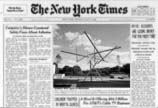
But the most refreshing of the new shows arrived more quietly. A. top spot on any list of shoms to be visited is recommended for: the recent sculptures by Kenneth Snelson that crept without fanfare into the Dwan Gallery, 29 West 57th Street.
Mr. Snelson's firmly engineered structures of porcelainized aluminum tubes held within space by delicate networks of thin stainless steel cables are sculpture only by today's elastic definition that encompasses any three dimensional work of art. Works of art these constructions certainly are, and an artist Mr. Snelson certalnly is. But he is at the same time an engineer, and his sculptures are, exercises in structural theory that have the special beauty of bridges, radio transmission towers, the skeletons of skyscrapers under construction and other industrial projects. The difference is that these objects exist without any functional purpose.
As a student of Buckminster Fuller in 1948 at Black Mountain College, Mr. Snelson developed the "tensegrity" principle of construction, a balance of push and pull forces" that would for the virtually infinite expansion of these relatively small demonstrations of the theory. Each is a tensible unit as self contained as a balloon, and the largest of them in this show (perhaps 12 by 14 feet) is so light that it is atmost as easily lifted as a chair. Handsome enough in the gallery, the large sculptures cry aloud for spots in any open area in city or in the countryside, or for suspension within interior architectural spaces. Pending that, there are also some small models that can sit on a table even in a New York apartment.
Large or small, these
constructions are pure diagrams, of tensional forces. They suggest in
a very direct way the structure of Gothic cathedrals while bearing no
formal resemblance to them. The medieval architects, dealing with thrust
and counterthrust in the stones of vaults and flying buttresses, might
have built the skeleton of Chartres on the "tensegrity" principle if the
materials had been available. The ethereality of Gothic space, the visual
denial of such inconveniences as the law of gravity, and above all the
dematerialization of matter, are logically continued in these despiritualized
symbols of modern science.
But although they are despiritualized, and totally transformed visually, the
taut metal webs are relatives of the cross-ribbed pointed vault, and they carry
the same impact of living forces brought into vital balances. One feels that
as demonstrations of a principle they only hint at revolutionary sculptural
and architectural possibilities.
So much -- just as an
introduction -- for that.